Thames Baths has known Theo Thomas for a number of years and so we thought it was about time he contributed to the blog. Theo is The London Waterkeeper. London Waterkeeper is a member of Waterkeeper Alliance, a global federation fighting for fishable, drinkable and swimmable water. London Waterkeeper is the capital’s only truly independent voice for rivers. Theo worked at Thames21 for 12 years. During this time he set up the ‘Love the Lea’ campaign to make members of the public aware of the problems facing London’s second river. He established its water quality testing laboratory. He was and is a big champion of green infrastructure to reduce the amount of pollution that reaches our rivers.
We asked Theo to tell us about his plans for making the Thames swimmable above Putney.
Thames Baths would bring swimming to the heart of London. Dedicated pools in one of the World’s iconic rivers, in front of its most famous landmarks. Swimming in the Thames in this central section is prohibited so a series of pools is the best option. It would be dangerous to swim in such a busy stretch of the river where tides and currents are strong.
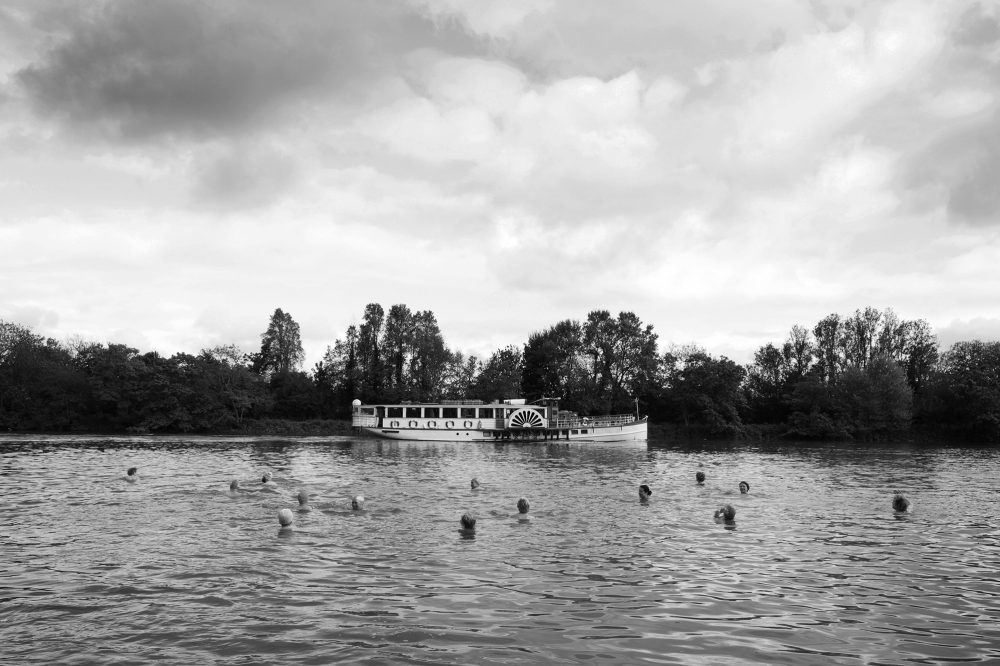
Upstream of Putney Bridge swimming is allowed but of course when and where is fundamental to safety. Upstream of Richmond Lock the Thames is semi-tidal, and beyond Teddington Lock non-tidal. Depending where you are the nature of the river is very different. People do swim in the Thames upstream of Putney, but it is a fraction of the potential numbers. I’ve swum at Twickenham shortly before high tide and it was an incredible experience. Access to the river in places like this, in London, and further out west is pretty good. In some locations swimming is a regular occurrence, in others the heyday is long past. Clearly to make parts of the Thames swimmable for many more people will be a challenge. It took Copenhagen ten years before you could swim in its harbours with confidence. But the rewards are immense. The mental and physical health of thousands of people would be boosted.
The biggest barrier is water quality. Sometimes the Thames meets bathing standards. At other times it fails them, but we don’t know when. We need to know when sewers overflow reducing water quality. Copenhagen has a real-time bathing water monitoring system. Seattle notifies the public when sewers spill, again in real-time. Other cities issue warnings when their sewage systems can’t cope. We’re some way behind that in the UK.

Public access to environmental information is crucial for a healthy democracy and sustained improvement of the environment. Currently too little is available and so it is hard to determine the real situation; whether standards are improving, about the same or worsening. In terms of going for a swim, kayak or paddleboard, river users are denied crucial information.
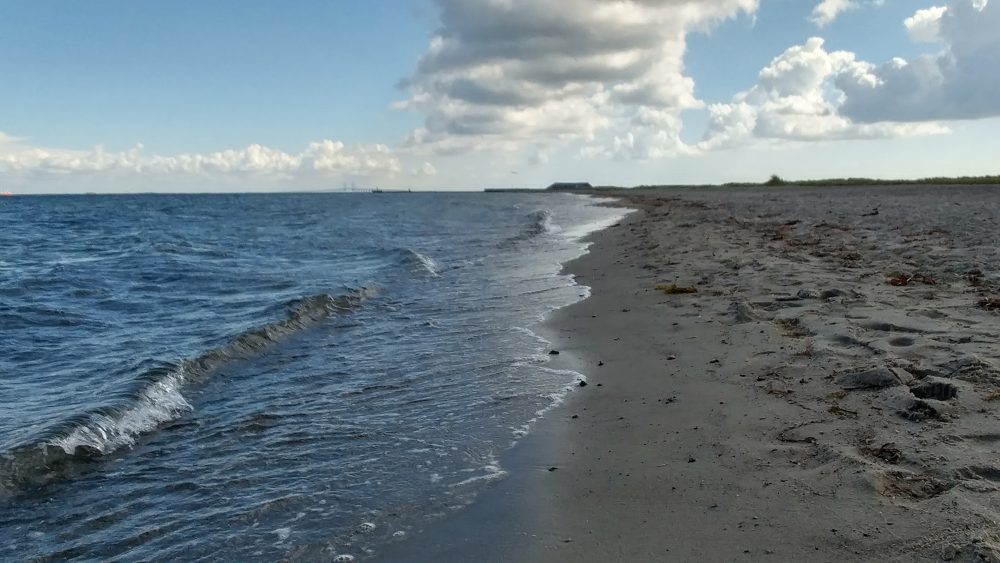
The Environmental Information Regulations 2004 say we should be told when sewers overflow and London Waterkeeper wants to see water companies meet their legal duties. If this data is combined with information technology we can have a powerful system that empowers river users (existing and potential). It will be a transformational change that deepens our connection with the Thames.
More information and how to donate:
• adventurer
• environment
• eu
• kayak
• london
• natural swimming
• News
• open water swimming
• outdoor swimming
• outdoorswimming
• paddleboarder
• paddleboarding
• putney
• River Thames
• rivers
• riverthames
• swim
• Swimming
• Thames
• Thames Baths
• thames water
• thamesbaths
• twickenham
• wild swimming
• winter swimming
During the UK’s recent heatwave, the Thames has looked increasingly irresistible. One blazing afternoon at Thames Baths HQ we stumbled upon a film about river swimming in Bern and posted it on our Facebook page.
Swiss-Canadian swimmer Mel Schori, then got in touch and offered to share his adventures in Bern with us.
Mel grew up in Nova Scotia, Canada but has spent the last 12 years living in and exploring Switzerland so who better to talk us through it!

Switzerland is one of the most beautiful countries in the world, with countless amazing spots to relax during a visit. But when the temperature climbs to the high twenties and low thirties during the summer months, you’ll need a place to cool down. Luckily, the capital city of Bern offers one of the “coolest” summer experiences around, and one of the best ways to beat the heat on a hot day.
The Marzilibad, a public swimming area just behind the Swiss houses of parliament in the center of Bern, is the place to be. Just a few Swiss Francs will get you entry to this swimming area (which also includes lush lawns and beach volleyball) as well as a locker to leave your things. If you’ve ever been to Switzerland before, you’ll know that almost nothing is cheap, so the cost factor is an even bigger bonus.
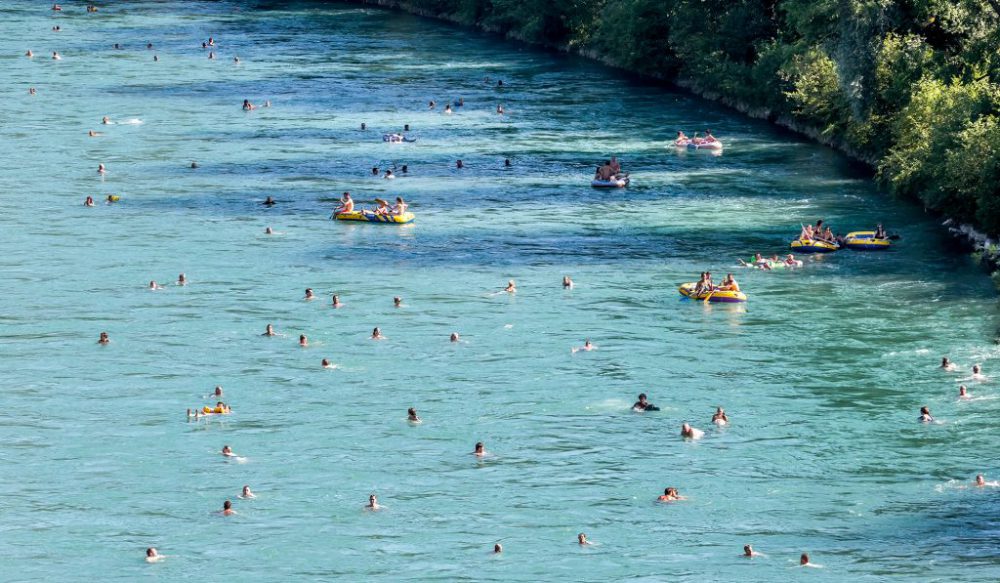
Once your things are locked away, you are ready to go! You’ll walk towards the water and follow the flow of people walking up river, along a paved path. The excitement builds at this stage. You just can’t wait to jump in the water as you see hundreds of people, young and old, floating by, all looking like they wouldn’t trade this for the world. Some are swimming with the flow of the river to race back towards Marzilibad, maybe trying to catch up with a friend. Some lay on their backs and carelessly float along, while others enjoy “river props”, like inflatable unicorns, swans and giant slices of pizza.
Along the way, you’ll see bridges covered with young people, mostly teenagers, who wait patiently for a safe time to show off their patented back flip. If you have the nerve, go and join them, but no stress, no one will make fun of your simple tin soldier bridge jump if you aren’t an Olympic diver 🙂

After walking for a little while (it takes about 15-20 minutes), you’ll come to an opening where most people decide to enter the river. You’re so warm you just can’t wait to cool down, but keep in mind, Swiss lakes and rivers are filled with water which flows down from the mountains, so be prepared to get really cool, really quickly! The river temperature is usually around 20 degrees Celsius during the summer.
Once you’re in, just enjoy it, you’ll adapt to the temperature within about 30 seconds. Swim, splash, float, joke, smile and laugh. It’s an absolutely fantastic time. The river flow is pretty strong though, so be careful if you aren’t the best swimmer. After what seems like 10 minutes of so, you’ll reach the Marzilibad again. It’s well set up with lots of bars to grab when exiting the water. There are also multiple places to get out, so that shouldn’t be an issue. Just keep your eye on other swimmers so you don’t float too far.
As soon as you get out, you just can’t wait to do it again. But when you’re ready for a break, there is plenty of room to lay in the grass and work on your tan, or stroll over to find a drink or ice cream (my girlfriend Rachel’s favorite). On a hot summer day, spending a few hours at the Marzilibad can only be described as “living the dream!”
Mel Schori, Zurich
• News
• open water swimming
• outdoorswimming
• rivers
• riverthames
• Swimming
• switzerland
• Thames
• thamesbaths
• zurich
Permits, Licences, Assessments…Understanding the complexities of building on the River Thames.
Tim Beckett of marine engineers Beckett Rankine talks us through working on Thames infrastructure projects.
Beckett Rankine are the marine consultants advising Thames Baths. Based in Westminster the firm works worldwide and has been responsible for the design of some of the world’s largest ports, such as Ras Laffan in Qatar. Closer to home Beckett Rankine has designed and helped gain consents for more than 200 projects on the tidal Thames over the last 20 years.
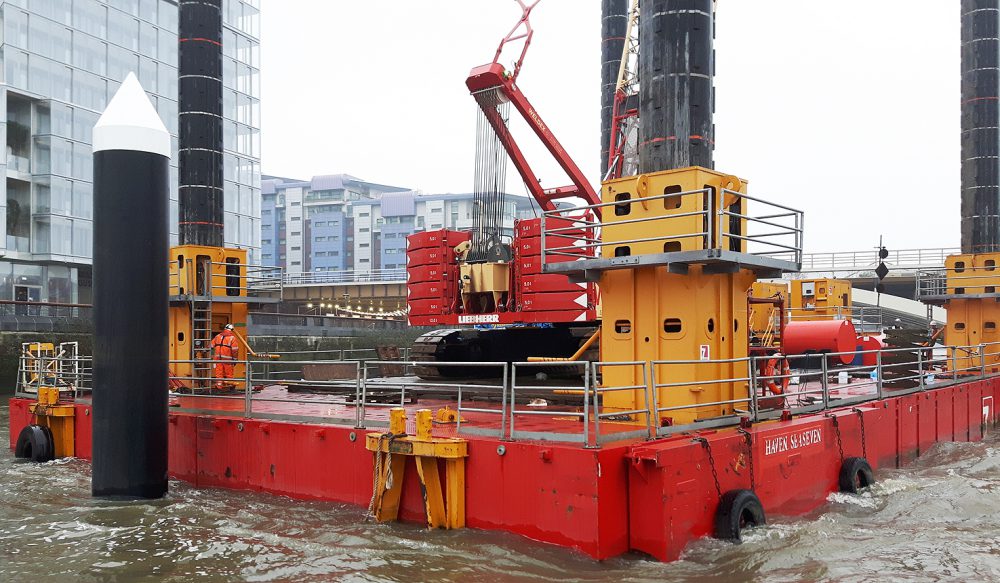
The Thames through central London is experiencing a level of construction activity unprecedented in living memory. Leading these projects is the Thames Tideway Tunnel (TTT) where construction of the first temporary wharf facility has recently started on site at Chambers Wharf. A similar cofferdam structure on the foreshore is due to commence shortly at King Edward Memorial Park with a new slipway for Shadwell Basin Activity Centre also being constructed.
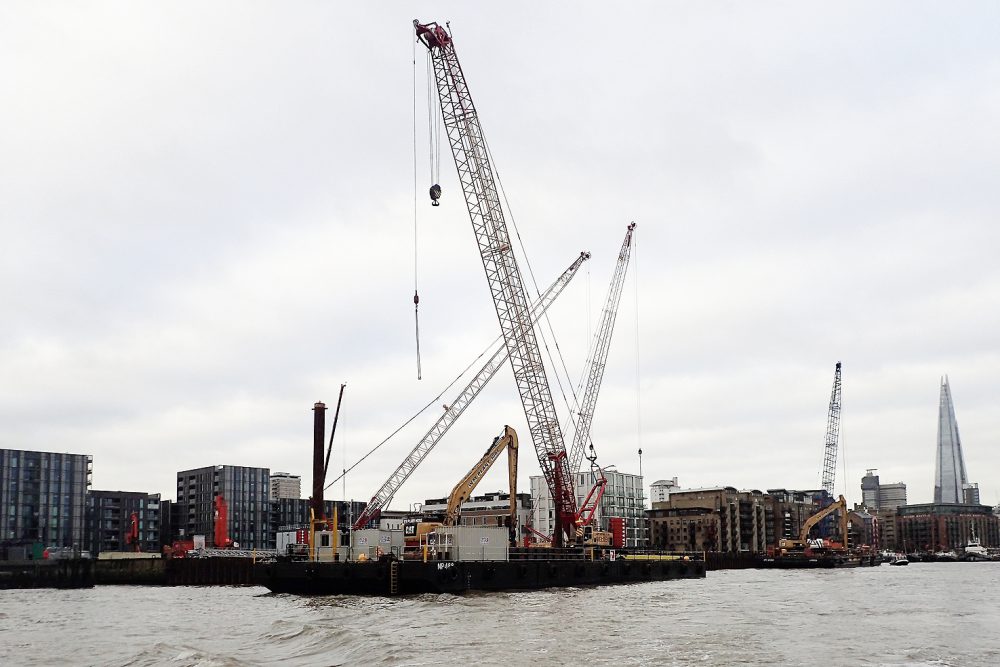
Other TTT sites due to commence construction in 2017 are at Blackfriars, Victoria Embankment, Kirtling Street, Albert Embankment, Chelsea Embankment, Cremorne Wharf, Putney and Hurlingham Wharf. Advance enabling works for the TTT project include the recently completed replacement of Blackfriars Pier and the moving of PS Tattershall Castle.
A sad departure from the river has been the HMS President which has been moved to Chatham Docks to make way for the TTT works at Blackfriars. We hope she will be returning to a new berth in the Upper Pool but that is by no means certain as it is dependent upon fundraising.
Non TTT projects for 2017 include a new passenger pier at Battersea Power Station which has just started on site. Planning permission has been granted for the Diamond Jubilee footbridge at Imperial Wharf while there are a number of other new or replacement piers in the pipeline; both Canary Wharf East and Royal Wharf piers should be delivered this year.
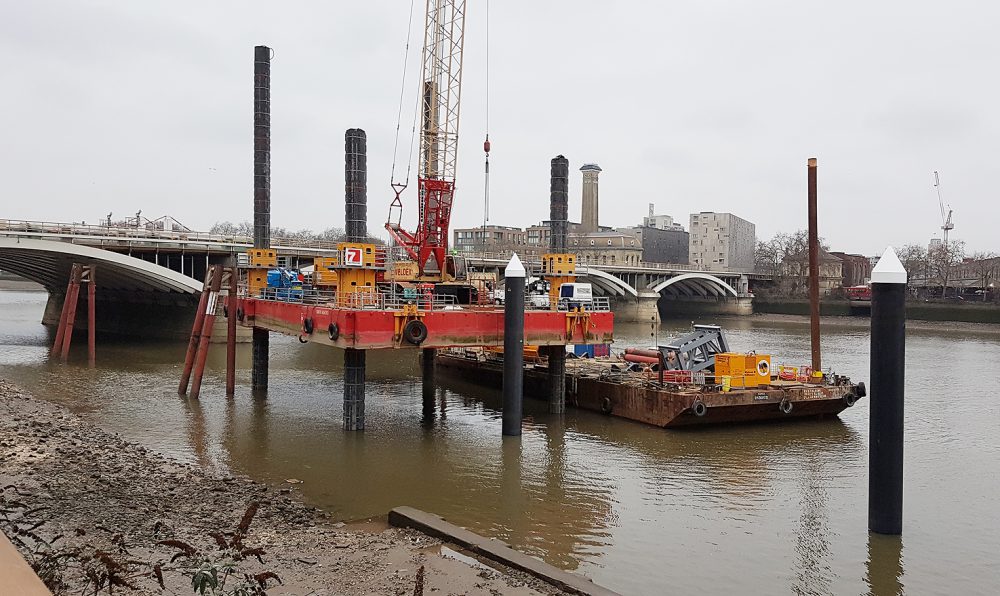
Beckett Rankine have been assisting many of these projects both with the engineering designs and also in obtaining the statutory consents. Obtaining consents for works within the river are much more time consuming than for land based developments. Planning permission from the local planning authority is required for any development but once planning is achieved, onshore development may not need any other consent other than complying with the Building Regulations.
If the project is in the Thames then in addition to planning consent the project will also require a River Works Licence from the Port of London Authority, a Land Drainage Consent from the Environment Agency and a Marine Licence from the Marine Management Organisation. These marine consents require a number of supporting studies such as a hydrodynamic assessment, ecological study, archaeological assessment and a navigational risk assessment. The navigational assessment can be particularly challenging as the Thames is a busy tidal river; areas where there is deep enough water for vessels to navigate at all states of the tide tend to be heavily trafficked.
While the river may look little used to a casual observer this is because the majority of the heavy freight movements take place an hour or two either side of high tide. Furthermore some of those movements, such as the tugs towing the waste barges, are difficult to manoeuvre and therefore need a generous clearance around them. Once the TTT starts excavation work in 2018 and the spoil is removed by river there will be a dramatic increase in freight movements for the navigational risk assessments to consider.

Despite these constraints the PLA’s new vision document, proposes to encourage increases in use of the river for freight, passenger vessels and sport and recreation. To deliver these intensified activities in central London without compromising safety will require an increasing degree of inventiveness.
• battersea
• batterseapowerstation
• beckettrankine
• consultants
• diamondjubileefootbridge
• engineering
• environment
• environmentagency
• hmspresident
• marine
• News
• pier
• pla
• River Thames
• riverthames
• Swimming
• Thames
• thamestideway
• thamestidewaytunnel
• tideway
• westminster